
The Best U.S. Cities for Cycling in 2025
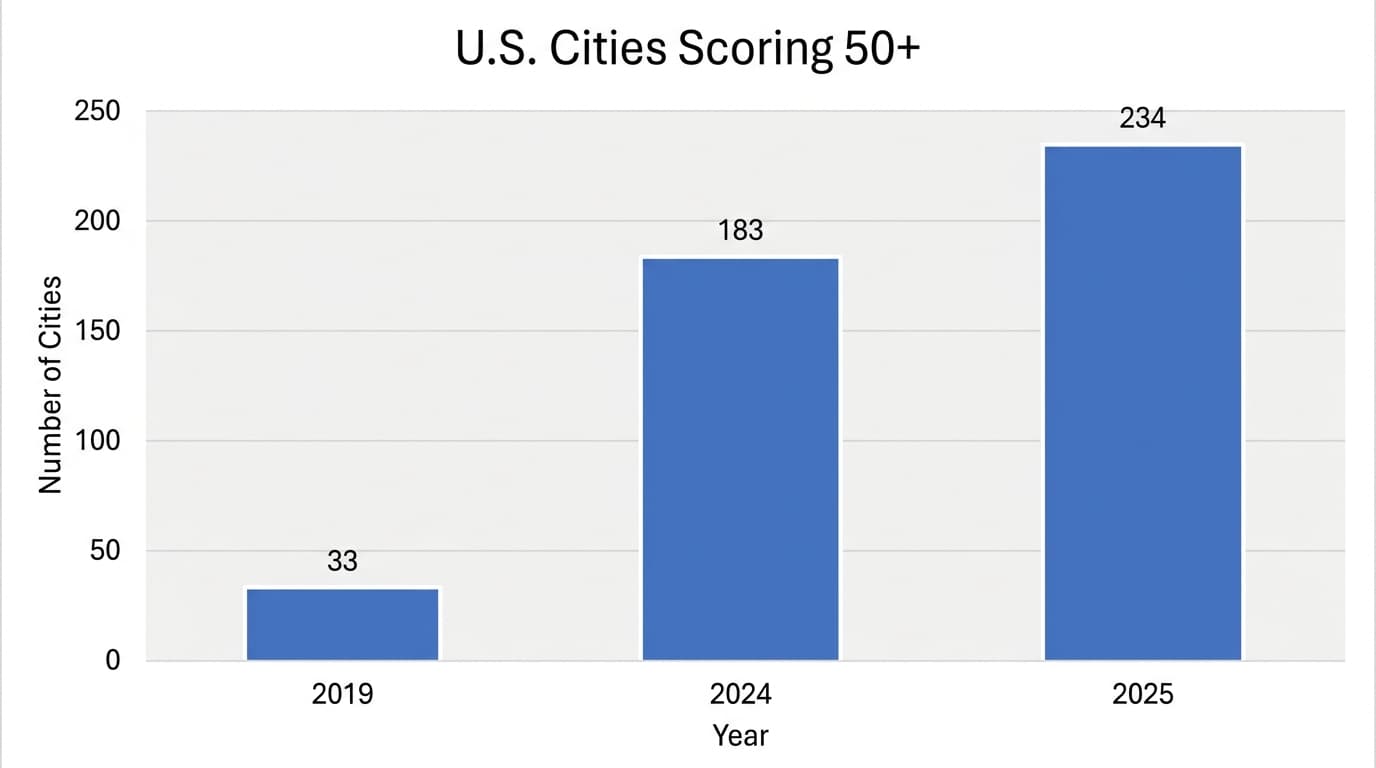
TL;DR: PeopleForBikes' 2025 City Ratings scored nearly 3,000 cities worldwide on bike infrastructure quality. Brooklyn topped the large-city rankings. Mackinac Island earned the first perfect 100 in program history. A total of 234 U.S. cities now score 50 or higher, up from just 33 in 2019. Whether you're planning a move, a trip, or pushing for change in your own town, the data shows that great cycling cities are growing fast.
If you're anything like me, the best rides aren't the ones you plan for weeks. They're the ones that start from your own doorstep. A Saturday morning with nowhere specific to go, a route that just works, and the feeling that your city actually wants you on a bike.
That feeling isn't random. It comes from infrastructure: protected lanes, connected trails, safe crossings, and streets designed for people on two wheels. And for the first time, we have a clear way to measure which cities deliver on that promise and which ones fall short.
The PeopleForBikes 2025 City Ratings evaluated nearly 3,000 cities across the U.S. and around the world, scoring each one on a 0 to 100 scale. This year brought a historic milestone: the first perfect score ever recorded. It also brought a new champion among large U.S. cities and proof that even the most unlikely places can become great for cycling.
Here's what the data tells us about the best cities for cycling in 2025, what's driving the changes, and what it all means for riders like you.
What Do the PeopleForBikes City Ratings Actually Measure?
The PeopleForBikes City Ratings evaluate the quality of a city's bike network on a 0 to 100 scale. The score reflects how well a city's cycling infrastructure connects neighborhoods, protects riders, and serves people of all ages and abilities. Higher scores mean more connected, safer, and more complete networks.
From a practical perspective, the ratings give cyclists something we've lacked for a long time: a standardized way to compare cities. The system breaks cities into three size categories (small, medium, and large) so that a town of 2,000 people isn't competing directly against a metro of 2 million.
New for 2025, PeopleForBikes integrated the City Ratings with its Great Bike Infrastructure Project. This means the ratings now track real-time progress on thousands of bike projects being built across the country. The connection between building infrastructure and improving scores is now visible in the data.
The 2025 cycle also expanded significantly. New York City was split into its individual boroughs, adding five new entries to the large-city category. The program added 185 new small cities and 51 new medium cities, bringing more communities into the picture than ever before.
The headline number that matters most? 234 U.S. cities now score 50 or higher. In 2019, that number was just 33. The trend is clear: what gets measured gets improved.
The Top 10 Large U.S. Cities for Cycling in 2025
The large-city rankings tell a story of change at the top. Brooklyn, NY dethroned Minneapolis to claim the number one spot with a score of 73. That's the result of years of dedicated investment in protected bike lanes and connected cycling networks across the borough.
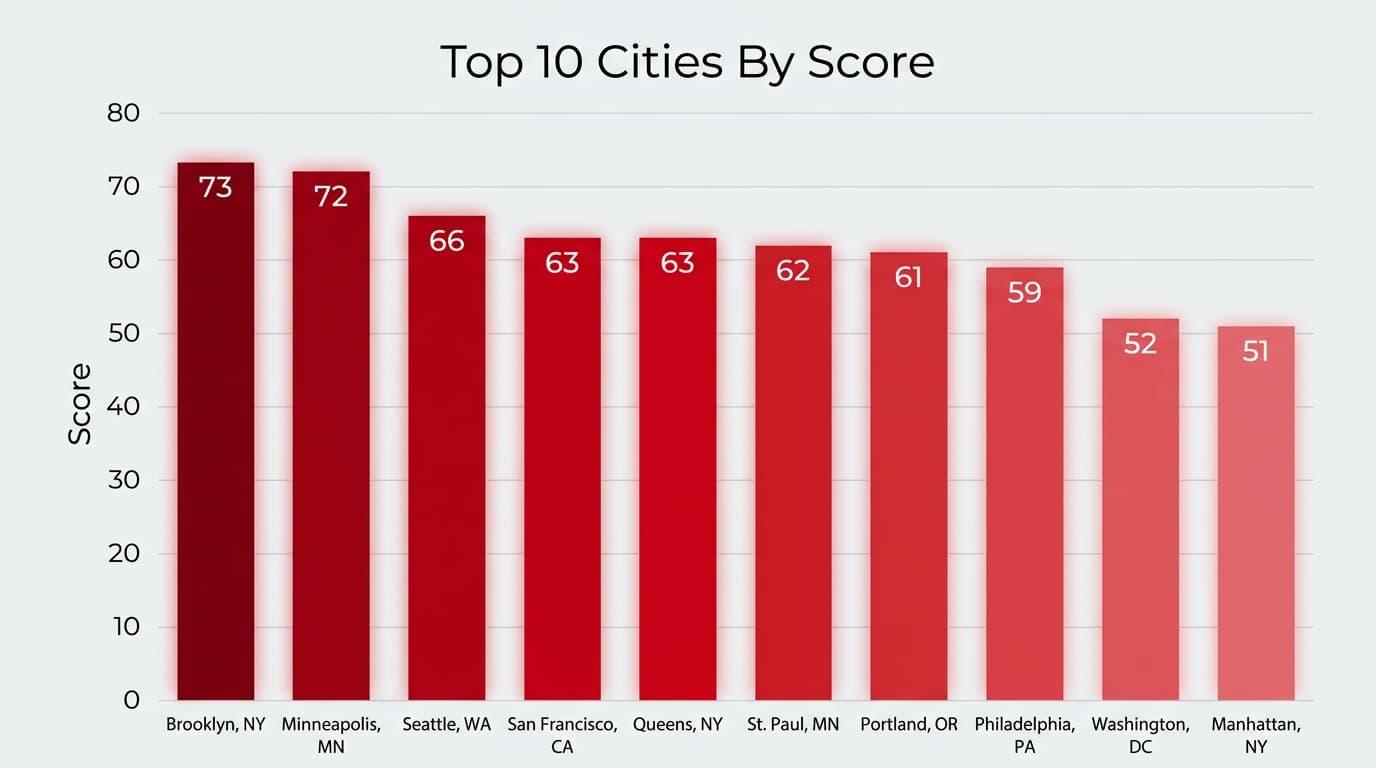
Here's the full top 10 for large U.S. cities:
- Brooklyn, NY (73)
- Minneapolis, MN (72)
- Seattle, WA (66)
- San Francisco, CA (63)
- Queens, NY (63)
- St. Paul, MN (62)
- Portland, OR (61)
- Philadelphia, PA (59)
- Washington, DC (52)
- Manhattan, NY (51)
A few things stand out. Minneapolis at 72 proves that brutal winters don't prevent great cycling. This is a city that regularly drops well below zero, yet it maintains one of the best bike networks in the country through year-round path maintenance and snow clearing. Seattle's 66-point score tells a similar story for rain. Climate isn't destiny.
The NYC borough split is also worth noting. With Brooklyn, Queens, and Manhattan all appearing in the top 10, cycling in New York looks different depending on which borough you're in. Brooklyn's 73 is world-class. Manhattan's 51 shows there's still significant room to grow, even in one of the most transit-rich places in America.
The good news is, in cities like these, you don't have to be a fearless cyclist to get around on two wheels. Protected lanes and connected networks mean everyday riders (not just the confident ones) can feel safe getting where they need to go.
NYC Borough Breakdown
Brooklyn (73), Queens (63), Manhattan (51). Same city, very different cycling experiences.
Which Mid-Size Cities Are Best for Everyday Cycling?
Mid-size cities often offer the best balance of quality bike infrastructure, lower traffic stress, and affordable cost of living. For many riders, they're the sweet spot between big-city investment and small-town calm.
Davis, California leads all medium cities with a score of 81, making it the highest-scoring city of any size in the U.S. (excluding small towns). Davis has been America's original bike town for decades, with cycling infrastructure that predates car-centric development. Its score puts it well ahead of every large city in the country.
The rest of the medium-city top 10:
- Davis, CA (81)
- Berkeley, CA (73)
- Corvallis, OR (71)
- Boulder, CO (70)
- Cambridge, MA (68)
- Hoboken, NJ (65)
- La Crosse, WI (65)
- Ankeny, IA (65)
- Ames, IA (64)
- Anchorage, AK (64)
There are some genuinely surprising names here. Ankeny and Ames show that Iowa is quietly building serious cycling infrastructure. Anchorage, Alaska, at 64, continues to demolish the assumption that cold weather prevents good biking. Between Minneapolis at number two among large cities and Anchorage placing in the medium-city top 10, the data makes it hard to use climate as an excuse.
I didn't realize this until I started looking at the numbers, but mid-size cities might be the best option for riders who want great infrastructure without big-city stress. If you're considering a move and cycling matters to you, these cities deserve a close look.
For riders in these communities, one thing to keep in mind: mid-size cities don't always have a bike shop on every corner. That's where finding a mobile bike mechanic near you can make all the difference. Someone who comes to you for tune-ups and repairs is especially valuable when the nearest shop is a drive away.
Size Doesn't Matter
Davis, CA (81) outscores every large city in America. The highest-rated places aren't the biggest.
Small Towns, Big Scores: The Charm of Small-City Cycling
Picture an island where cars don't exist. Where bikes are the main way people get around, not because of some policy experiment, but because that's how life has always worked there. That's Mackinac Island, Michigan, and this year it earned something no city has ever achieved: a perfect score of 100 in the PeopleForBikes City Ratings.
It's the kind of place that makes you rethink what "bike-friendly" really means. Sometimes the best places to ride aren't cities at all.
The small-city rankings are full of surprises:
- Mackinac Island, MI (100)
- Provincetown, MA (96)
- Sauk City, WI (90)
- Washburn, WI (89)
- Springdale, UT (89)
- Murdock, NE (89)
- Fayette, MO (89)
- Fort Yates, ND (88)
- Crested Butte, CO (87)
- Perrysville, OH (85)
Look at where these towns are. Nebraska. Missouri. North Dakota. Ohio. These aren't the places most people picture when they think about great cycling. Yet they're outscoring major metros by wide margins.
Wisconsin deserves a special mention. Multiple Wisconsin small towns rank near the top, and the statewide average City Ratings score sits at 48. That's higher than many individual large cities. Something is working in America's Dairyland.
If you're anything like me, you'd assume these small towns all have a bike shop on main street. Most don't. That's where mobile bike mechanics become essential, especially for visiting riders who need a quick fix far from home.
Small towns and trail communities offer some of the purest, most enjoyable cycling experiences in the country. The scores prove it.
Which Cities Are Improving the Fastest for Cyclists?
The cities improving fastest are the ones making deliberate, sustained investments in bike infrastructure. PeopleForBikes tracks these "Cities on the Rise," and the improvement stories are often more compelling than the top rankings themselves.
The most dramatic turnaround belongs to St. Paul, Minnesota. In 2020, St. Paul scored just 9 points. Five years later, it sits at 62, a 53-point jump that now places it in the top 10 large U.S. cities. That's not a statistical quirk. That's what happens when a city commits real resources to building a connected bike network over several years. For riders in cities that feel hopeless right now, St. Paul is proof that transformation is possible.
The St. Paul Turnaround
From 9 points in 2020 to 62 in 2025. The biggest comeback in City Ratings history.
PeopleForBikes' official "Cities on the Rise" list highlights several other standouts:
- Corvallis, OR (71): leading the improvement list
- Anchorage, AK (64): massive gains for a city most wouldn't associate with cycling
- Asbury Park, NJ (61): a Jersey Shore town investing in bike infrastructure
- Chico, CA (57): Northern California building momentum
- Peachtree City, GA (50): crossing the 50-point threshold as a notable Southern city
- Montrose, CO (43) and Evanston, IL (43): still climbing
- Bethesda, MD (41): DC suburb getting in the game
Beyond the official list, the broader data shows cities like Park City, UT (48 to 61), Richfield, MN (25 to 53), and Phoenixville, PA (21 to 50) making enormous leaps. Among large cities, Washington, DC saw the biggest jump, climbing from 46 to 52.
The bigger picture is encouraging. 80% of U.S. cities have improved their scores since 2020, with 22% improving by 10 or more points.
The good news is, if your city isn't great for cycling yet, it might be getting better faster than you think. And that's worth getting excited about.
How Does the U.S. Compare to Europe for Cycling?
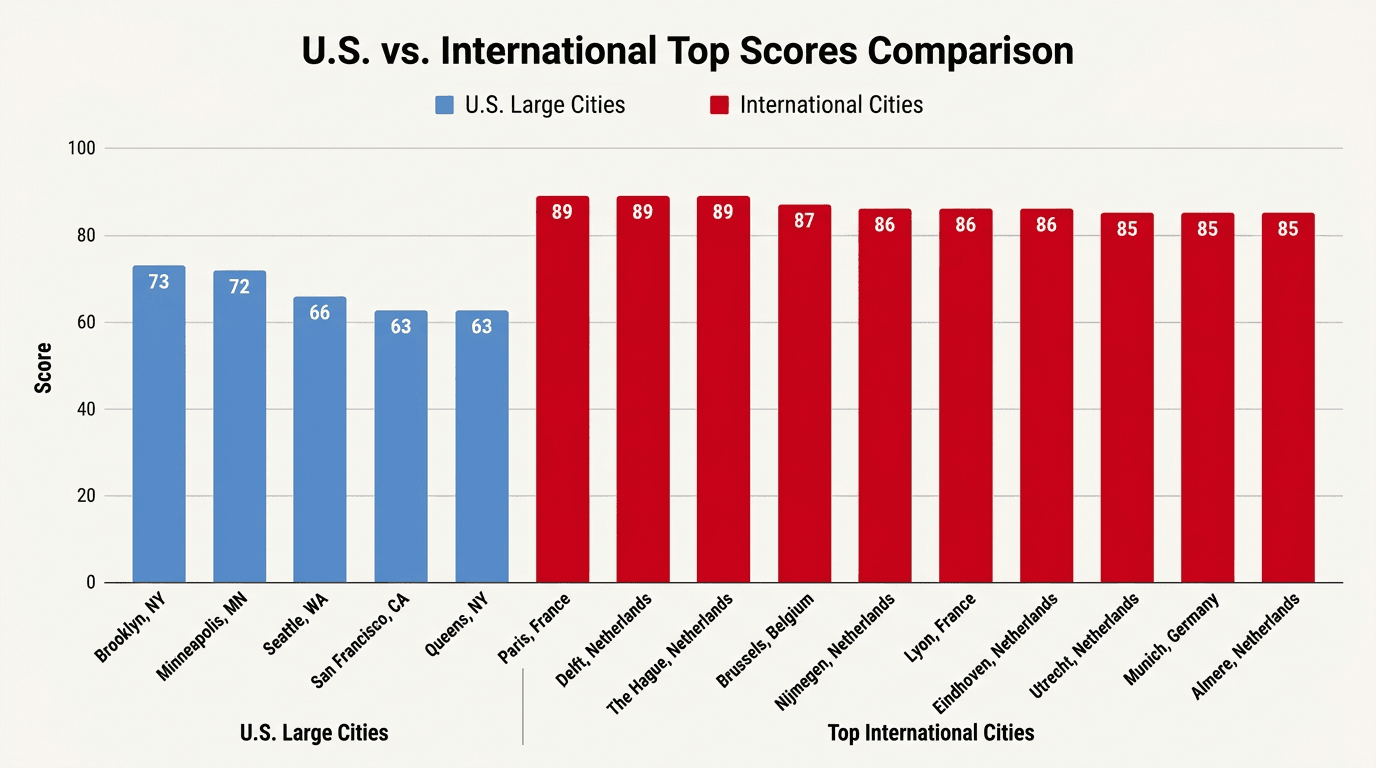
The best U.S. city for cycling (Brooklyn, at 73) would rank behind most top European cities. The Netherlands, France, and Belgium dominate the international City Ratings, with scores that show what decades of national-level cycling investment look like.
Here's how the international top 10 shapes up:
- Paris, France (89)
- Delft, Netherlands (89)
- The Hague, Netherlands (89)
- Brussels, Belgium (87)
- Nijmegen, Netherlands (86)
- Lyon, France (86)
- Eindhoven, Netherlands (86)
- Utrecht, Netherlands (85)
- Munich, Germany (85)
- Almere, Netherlands (85)
The Netherlands fills six of the top 10 spots. Paris, which has undergone a dramatic cycling transformation in recent years, ties for first at 89. The gap between Brooklyn's 73 and the European leaders' 89 tells a story about infrastructure investment at a national level, not just a city level.
The UK sits in between. Cambridge (84), Hackney (83), Islington (82), and Newham (82) represent strong performances, particularly among London boroughs. Edinburgh (79) and Brighton (78) are also notable.
For riders, the takeaway is simple. The Netherlands and France set the global standard for cycling infrastructure. But U.S. cities are closing the gap, and the pace of improvement suggests the distance will keep shrinking.
What Makes a City Great for Cycling: Lessons from the Data
In many cases, the cities at the top of the rankings share a few things in common. It's not one single feature that makes a city great for cycling. It's a combination of connected systems working together.
The common threads among top-rated cities include connected networks of protected bike lanes (not just isolated segments), off-street paths and trails that serve as real transportation corridors, safe crossings and intersections designed with cyclists in mind, and slow shared streets in residential areas.
PeopleForBikes developed the SPRINT framework to help cities put these principles into action. Using Chicago as a case study, the framework outlines practical steps any city can take to improve its cycling infrastructure, regardless of size or budget.
The national infrastructure pipeline backs this up. PeopleForBikes now tracks 2,779 bike projects across the country: 17% proposed, 23% approved, 32% funded, and 21% completed. By project type, 47% are off-road trails or paths, 36% are protected bike lanes, and 11% are other bikeways.

Since 2013, the U.S. has built over 4,400 miles of protected bike lanes. That number was essentially zero a decade before. The protected bike lane movement has gone from a handful of pilot projects to a nationwide infrastructure category.
These improvements don't happen in a vacuum. They coincide with the e-bike boom that's broadening who rides and how far. E-bikes make hilly cities like San Francisco more accessible. They extend practical commute distances well beyond what a traditional bike allows. And they bring new demographics onto the network: older riders, families with cargo bikes, and commuters who previously considered cycling impractical.
More riders of more types using more of the network means infrastructure quality matters even more than it used to. And more riders also means more demand for maintenance. E-bikes in particular have more complex service needs than traditional bikes, including batteries, motors, and specialized drivetrains. Mobile bike mechanics who can service e-bikes where riders live and work are becoming an essential part of the cycling ecosystem.
How Can You Use the City Ratings to Plan Your Next Ride?
You can use the PeopleForBikes City Ratings to compare cities for relocation, plan cycling-focused trips, or identify what your own city needs to improve. The interactive ratings explorer lets you search any rated city and see its score, sub-metrics, and trend over time.
If you're planning a move and cycling matters to you, check your target city's score and how it's changed in recent years. A city at 45 that was at 30 three years ago might be a better bet than a city stuck at 50. The trajectory matters as much as the current number.
For trip planning, consider visiting a "City on the Rise" to experience the momentum firsthand. Cities in the middle of a cycling transformation have a particular energy, with new lanes going in, riders discovering new routes, and a sense that things are getting better.
If your city isn't rated yet, PeopleForBikes accepts applications for the 2026 cycle. Getting your city measured is the first step toward getting it improved.
And if you want to push for change, here's where to start. The data shows that cities that engage with the ratings tend to improve. PeopleForBikes' SPRINT principles (covered above) offer a practical framework. Beyond that, attend city council meetings where bike infrastructure is discussed. Connect with local advocacy groups. Document and report unsafe conditions. Support bike-friendly businesses. Show up for group rides, because visible ridership demonstrates demand. The St. Paul story is the proof point: systematic investment transforms a city's score and its streets.
Wherever you ride, having reliable bike maintenance makes the experience better. FindBikeDocs connects you with mobile mechanics who come to you, whether you're in a top-rated cycling city or a town that's still building out its network.
The Future of Cycling in American Cities
The numbers point in one direction. Scores are rising. Projects are getting funded and built. More cities are taking cycling seriously than at any point in American history.
The first perfect score (Mackinac Island's 100) is symbolic. It shows what's possible when a community fully commits to cycling as a way of life. But the more meaningful story might be the 234 cities now scoring 50 or higher, each one representing real infrastructure that real riders use every day.
With 2,779 bike projects in the national pipeline and 80% of cities trending upward, the 2026 ratings should show even more cities crossing the 50-point threshold. The momentum is structural, not anecdotal.
So explore the ratings. Advocate for your community. And most importantly, get out and ride. The best thing about great cycling cities is that they make you want to keep pedaling.
As cycling grows, so does the need for the services that support it. Find a mobile bike mechanic near you so that a flat tire or a skipping chain never keeps you off the road.
By the Numbers — ~3,000 cities rated worldwide
- 234 U.S. cities scoring 50+
- 80% improved since 2020
- 4,400+ miles of protected bike lanes built
- 2,779 projects in the pipeline
Frequently Asked Questions
What is the most bike-friendly city in America?
It depends on city size. Among large U.S. cities, Brooklyn, NY leads with a score of 73 in the 2025 PeopleForBikes City Ratings. Among medium cities, Davis, CA tops the list at 81. And among small cities, Mackinac Island, MI earned the first perfect score of 100 in program history.
How are the PeopleForBikes City Ratings calculated?
The City Ratings use a 0 to 100 scale that measures the quality, connectivity, and safety of a city's bike network. Cities are grouped by population size (small, medium, and large) so that communities of different scales can be compared fairly. For 2025, the ratings also integrate with PeopleForBikes' Great Bike Infrastructure Project, tracking real-time progress on thousands of bike projects.
Can cold-weather cities be good for cycling?
Yes. Minneapolis, MN scores 72 (second among large cities) despite brutal winters. Anchorage, AK scores 64 as a medium city. Both cities show that year-round commitment to path maintenance and snow clearing makes cycling viable in any climate.
What U.S. city improved the most for cycling?
St. Paul, MN made the most dramatic improvement, jumping from a score of 9 in 2020 to 62 in 2025. That 53-point increase is the largest in City Ratings history. Other notable improvers include Richfield, MN (25 to 53) and Phoenixville, PA (21 to 50).
How many U.S. cities are considered bike-friendly?
As of the 2025 ratings, 234 U.S. cities score 50 or higher on the PeopleForBikes scale. That's up from just 33 cities in 2019. Overall, 80% of U.S. cities have improved their scores since 2020.
How does the U.S. compare to Europe for cycling?
The top U.S. city (Brooklyn, at 73) scores well below international leaders like Paris, Delft, and The Hague, all at 89. The Netherlands and France dominate the global rankings. However, U.S. cities are improving steadily, and the gap is narrowing each year.
Cover Photo by Jefferson Fernandes: Pexels.com